
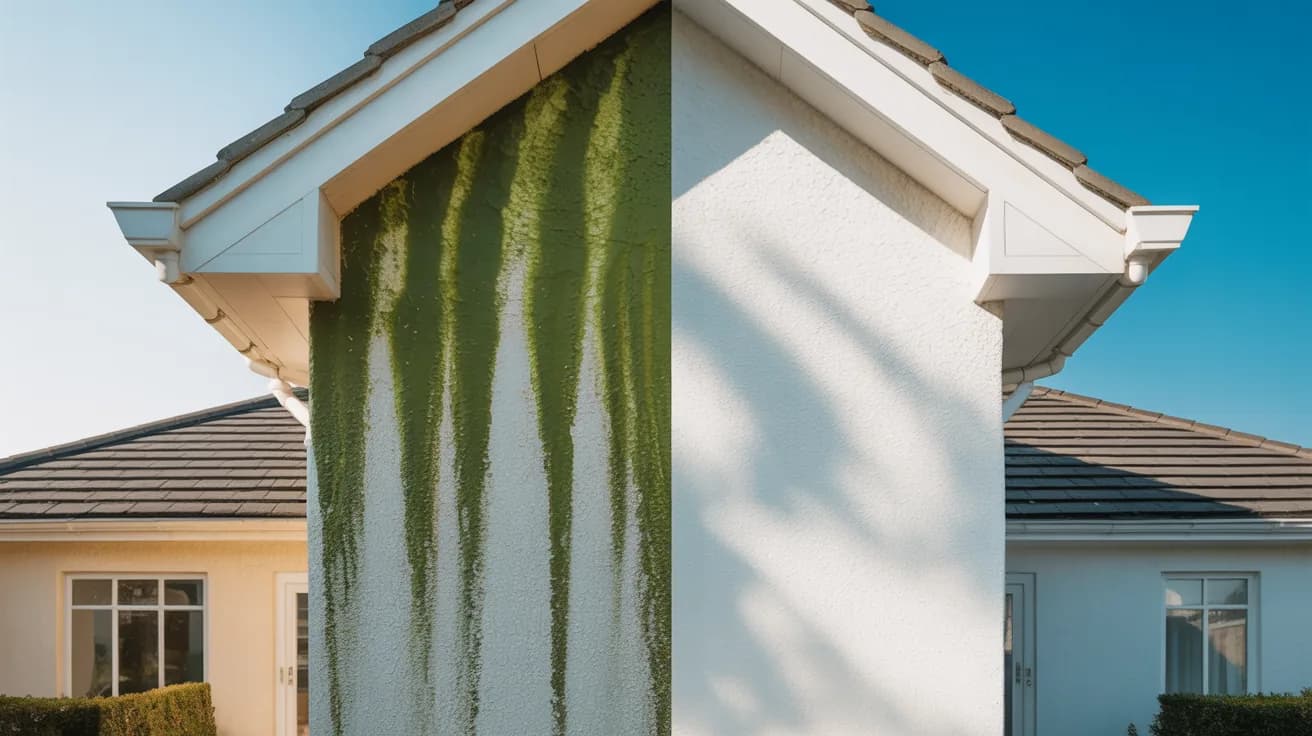
Render Cleaning and K-Rend Softwashing
Low pressure softwashing that kills green and red algae at root level without opening up the render.
Family-run
Justin and the team do the work. No call centres, no subcontractors.
Fully insured
Full public liability cover on every job, domestic or commercial.
Safe methods
Biodegradable products and low pressure, matched to the surface.
Free quotes
No obligation, and no charge for coming out to look at the job.
What render cleaning actually involves
Render cleaning is a softwash: low pressure water, no stronger than a garden hose, carrying a biodegradable biocide that kills algae, mould and lichen in the surface of the render. The wall is wetted down, treated, given proper dwell time and then rinsed gently. The growth dies at root level and the discolouration lifts over the following days and weeks. No lance, no rotary head, and no pressure that could open the render or push water behind it.
Render is the surface we get called out to most, and it is also the one that gets ruined most often. The marks on it are biological: green algae, black algae and a red or pink algae that shows up strongly on white and cream walls. None of it is dirt in the ordinary sense, so scrubbing and blasting do not deal with it. Kill the growth at root level with a biocide applied at low pressure and the wall clears as the dead growth weathers off.
Red algae confuses people. It looks like rust or staining bleeding out of the wall itself, and it usually appears in patches rather than the vertical runs you get with green algae. It is still a living organism and it responds to the same treatment, though it often takes longer to fade completely because the pigment sits down in the surface. Green algae is the one that streaks from sills, gutter joints and anywhere rainwater runs the same line every time.
Jet washing render is the most expensive mistake a homeowner can make on their own house. A lance opens the surface of a through-coloured render, drives water into and behind it, blows out the seal around beads and reveals every patch repair the wall has ever had. K-Rend and silicone systems are specifically not designed for it. Once that surface is opened it holds water and dirt faster than before, so the wall greens up sooner and the next clean is harder.
Suitable for
- K-Rend and other through-coloured silicone renders
- Monocouche render on newer housing and extensions
- Painted render and pebbledash on older Lancashire property
- Rendered gables, dormers and chimney stacks
- Rendered garden, boundary and retaining walls
- External wall insulation systems where the surface must not be opened
Problems it solves
- Green algae streaking down from sills, window heads and gutter joints
- Red or pink algae patches that look like the wall is staining from inside
- Black spotting and mould on shaded north and west elevations
- White render gone a uniform grey so it no longer matches the trim
- Being told the wall needs repainting or re-rendering when it only needs cleaning
- Damage risk from a general cleaner turning up with a pressure lance
How we approach render cleaning
Identify the render system
We establish what the wall actually is: K-Rend, another silicone render, monocouche, sand and cement with paint, or an insulated system. The system dictates dilution, dwell time and how the elevation is rinsed.
Protect the surroundings
Planting, lawns, block paving, glazing, timber and garden furniture below the work area are wetted down and sheeted. Wetting plants first is what stops any solution being taken up by the roots.
Test patch where needed
On an older coating, an unusual finish or a colour we have not treated before, we do a small area out of sight first and let it react fully before committing to a whole elevation.
Low pressure application
Biocide is applied at garden hose pressure from the top down, in sections, so no part of the wall dries out before it has had its dwell time. Coverage is even from edge to edge and corner to corner.
Dwell and gentle rinse
The solution is left to work and then rinsed off gently. Some discolouration lifts on the day. Red algae and heavy lichen keep fading for days or weeks afterwards as the dead growth weathers away.
Final walk round
We check the elevation from the ground in daylight, rinse down everything below it, and flag what we noticed: a cracked bead, a blocked weep hole, the leaking gutter joint that caused the streak.
What you get
- No pressure on the render, so nothing is opened up and no water is driven behind the surface
- Growth killed at root level, so regrowth is slow rather than immediate
- Works on red and pink algae as well as the more familiar green streaking
- Safe on K-Rend, silicone and monocouche, where jet washing does real damage
- Far cheaper than the repainting or re-rendering people are often told they need
- Biodegradable biocide, with planting wetted and sheeted before anything is applied
Render Cleaning questions
Related services
- SoftwashingLow pressure cleaning with a biodegradable biocide that kills algae, l
- Roof CleaningMoss stripped off by hand and killed at the root, with the gutters and
- Brick CleaningMortar haze, soot staining and green growth taken off brickwork withou
- Cladding CleaningPanel systems, aluminium and UPVC cleaned by the right method for each
Need render cleaning doing?
Free quotes, no obligation, and an honest answer about whether the job actually needs doing.