Roof Cleaning and Moss Removal
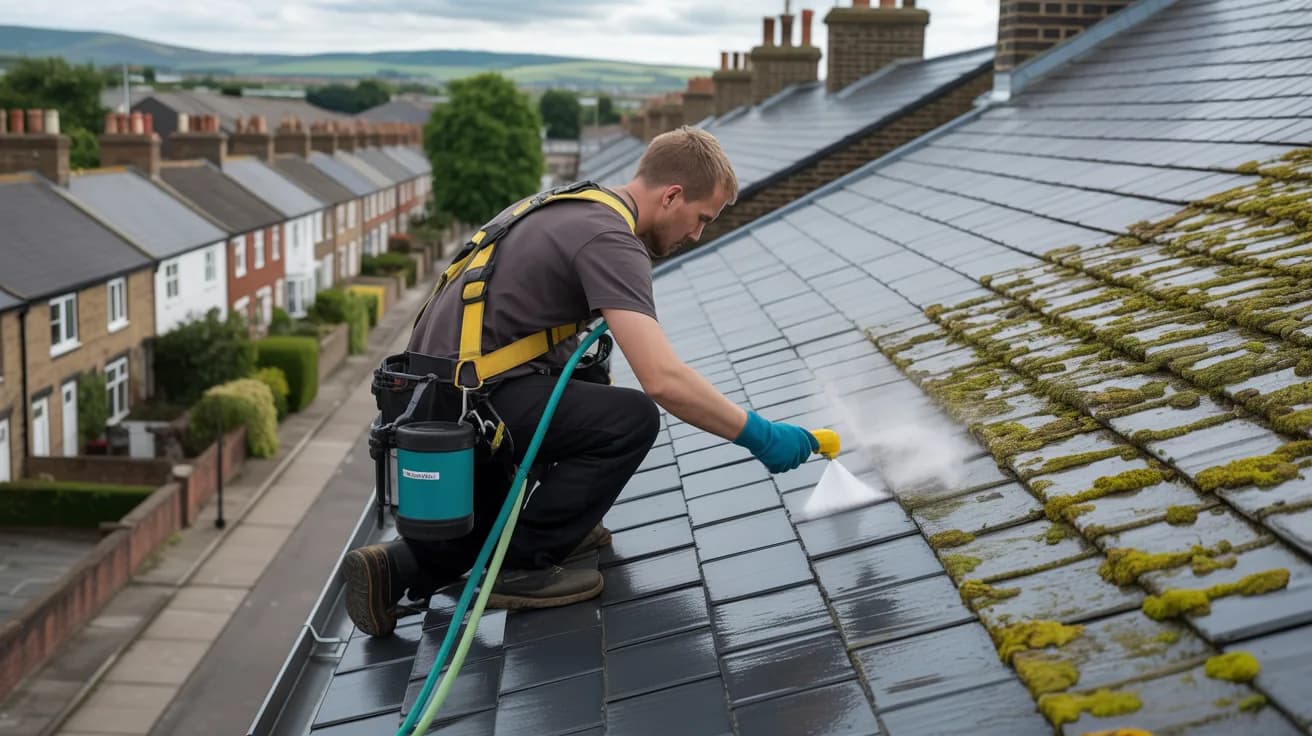
Moss stripped off by hand and killed at the root, with the gutters and downpipes cleared before we leave.
Family-run
Justin and the team do the work. No call centres, no subcontractors.
Fully insured
Full public liability cover on every job, domestic or commercial.
Safe methods
Biodegradable products and low pressure, matched to the surface.
Free quotes
No obligation, and no charge for coming out to look at the job.
What roof cleaning actually involves
Roof cleaning is the removal of moss, lichen and algae from tiles or slates, followed by a biocide treatment that kills the remaining spores at root level. The moss comes off by hand with scrapers and brushes and is collected rather than washed into the gutters. The biocide is applied afterwards at low pressure once the roof is clear. The point is not only appearance: growth holds water against the tile, and water that freezes is what cracks it.
Moss on a Lancashire roof is not just a cosmetic problem. Every clump holds water against the tile, and when that water freezes it expands and lifts the face of the tile away. Do that for enough winters and you get spalled concrete, flaking slate and tiles shedding grit into the gutters. We take the moss off physically first, then treat what is left with a biocide so the spores die rather than simply being knocked off the surface.
The pitch matters as much as the material. North-facing slopes and anything shaded by sycamore or beech stay damp for most of the year, which is exactly what moss wants. The south-facing elevation on the same house is often nearly clean. That is why we look at the whole roof before quoting rather than pricing off a photograph, and why we check the valleys, the gutter line and the flashings at the same time.
We never jet wash a concrete tile roof. The coloured slurry on the face of a concrete tile is what keeps it shedding water, and a lance strips it in seconds, leaving a roof that looks clean for one season and then greens up faster than before. Manual removal followed by biocide takes longer, but it does not shorten the life of the covering. Access is planned before we start, using scaffold, a tower or roof ladders depending on pitch and height.
Suitable for
- Concrete interlocking tiles on post-war and modern housing
- Natural and man-made slate roofs
- Stone slate roofs on Ribble Valley barns, cottages and farmhouses
- Clay pantiles and plain clay tiles
- Garage, extension, porch and conservatory roofs
- Bungalows and dormers where the roof is a large part of what you see
Problems it solves
- Thick moss holding water against the tile through winter frosts
- Gutters and downpipes blocking with moss and grit washed off the roof
- Black algae streaking down slate and dark staining on shaded elevations
- Lichen crusts that pit and lift the surface of clay and concrete tiles
- Loose moss dropping onto patios, cars and conservatory roofs
- A tired roof that lets down an otherwise well kept house
How we approach roof cleaning
Roof and access survey
We look at both pitches, the valleys and the gutter line, and confirm the tile type. Access is agreed at this point: scaffold, tower or roof ladders, depending on the pitch and the height involved.
Ground protection and gutter check
Drives, patios, borders and any glazed roofs below are sheeted before work starts. We check the gutters first so everyone knows what was already sat in them before a single clump of moss comes down.
Manual moss removal
Moss and lichen come off by hand with scrapers and stiff brushes, working down the pitch so nothing is driven up under the laps. No lance, no rotary head, no pressure applied to the tile face.
Gutter and downpipe clearance
Everything dislodged is cleared out of the gutters, hoppers and downpipes, then the run is flushed and checked for flow. Skip this and a clean roof turns into an overflowing gutter in the first heavy rain.
Biocide treatment
A biodegradable biocide is applied at low pressure across the whole covering. It kills the spores and root material still sat in the pores of the tile, so regrowth is slow instead of immediate.
Clear up and report
Moss is bagged and taken away rather than swept into the borders, paths and drives are washed down, and we tell you about anything we saw up there: a slipped tile, loose ridge bedding, a cracked valley.
What you get
- Frost damage stops where the moss stops, because nothing is left holding water on the tile
- Gutters and downpipes cleared in the same visit rather than paid for twice
- No slurry stripped off concrete tiles and no water driven under the laps
- Slower regrowth, because the biocide kills root material instead of knocking growth off the face
- All moss bagged and removed from site
- An honest report on anything we spot while we are up there
Roof Cleaning questions
Roof Cleaning near you
We cover the Ribble Valley and the surrounding towns from our base in Clitheroe.
Related services
- Roof SprayingA coating for a roof that is sound but faded, applied only after the t
- SoftwashingLow pressure cleaning with a biodegradable biocide that kills algae, l
- Render CleaningLow pressure softwashing that kills green and red algae at root level
- DOFF Superheated Water CleaningChemical free stone cleaning at up to around 150C and very low pressur
Need roof cleaning doing?
Free quotes, no obligation, and an honest answer about whether the job actually needs doing.