Pressure Washing for Hard Surfaces, and Honest Advice on the Rest
The right tool for block paving, concrete and stone flags, and the wrong one for render, roof tiles and historic masonry.
Family-run
Justin and the team do the work. No call centres, no subcontractors.
Fully insured
Full public liability cover on every job, domestic or commercial.
Safe methods
Biodegradable products and low pressure, matched to the surface.
Free quotes
No obligation, and no charge for coming out to look at the job.
What pressure washing actually involves
Pressure washing forces water through a narrow nozzle at high pressure to physically remove dirt, moss and staining from hard surfaces. It cleans by force, which is why it works so well on concrete, block paving and stone flags, and why it is unsuitable for anything with a coating, a soft face or an open joint. Machines are adjustable, and matching pressure, nozzle angle and standoff to the surface is the difference between a clean and a permanent scar.
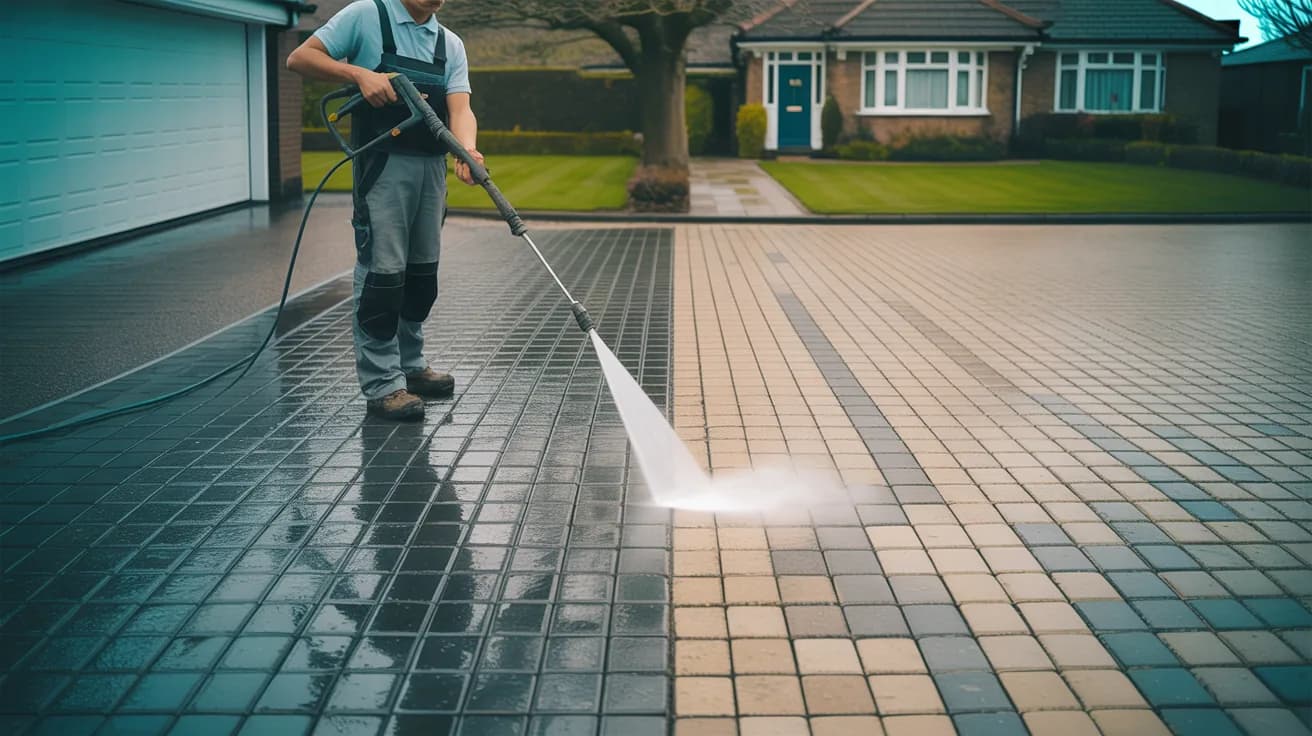
Pressure washing has a real job to do, and we do plenty of it. On block paving, concrete, stone flags, steps and hard standing, mechanical force is the quickest and most effective way to shift ground in dirt, tyre marks, moss in the joints and years of general grime. Used on the right surface with the right nozzle and the right standoff, it gives a result that no other method matches.
It is also the method behind most of the damage we get called out to look at. Jet washing render opens the face and pushes water in behind it. Jet washing a concrete tile roof strips the surface slurry and takes years off the tile. On soft sandstone it cuts the face and leaves banding you cannot undo. Those surfaces need softwashing or DOFF, and we will say so at the quote rather than take the work.
So the survey decides the method, not a price list. In practice a lot of properties end up with both: the drive and patio pressure washed and re-sanded, the render and roof softwashed on the same visit. You get one visit, one team and the correct treatment on each surface, instead of one machine used on everything because it happens to be on the van.
Suitable for
- Block paving driveways, paths and setts
- Concrete hard standing, garage aprons and steps
- Indian sandstone, York stone and riven flag patios
- Porcelain paving and modern textured slabs
- Yards, loading bays and commercial forecourts
- Sound modern brick paving and hard landscaping edges
Problems it solves
- Black, slippery algae film across paving, paths and steps
- Moss and weeds growing up through block paving joints
- Tyre scuffs, oil spots and ingrained dirt on a driveway
- A patio that has gone green and become genuinely dangerous underfoot
- Jointing sand washed out, leaving blocks loose and moving
- Leaf litter staining and tannin marks under overhanging trees
How we approach pressure washing
Survey and method decision
We check what the surface actually is before quoting. Some jobs turn out to need softwashing instead, and where that is the case we say so and price it that way rather than reaching for the jet wash.
Clearing and preparation
Furniture, pots and vehicles are moved off, loose debris is swept up, and we check drains and gullies so that silt has somewhere to go without blocking anything up.
Weed and moss removal
Established weeds and thick moss are pulled or scraped out of the joints first. Blasting them out wastes time, spreads seed across the surface and drives more material into the drainage.
Pressure cleaning
We work in overlapping passes at a pressure and standoff matched to the surface, usually with a rotary head on paving to keep the finish even and avoid the striping a hand lance leaves.
Rinsing and re-sanding
Silt is rinsed off, then block paving joints are refilled with kiln-dried sand and brushed in. Joints left empty let the blocks shift and let weeds straight back in again.
Optional sealing
Once the surface is fully dry, which usually means a separate visit, a sealer can be applied to slow staining and make future cleaning easier. It is optional and we say where it is worth it.
What you get
- Fast, thorough results on concrete, block paving and stone flags
- Kiln-dried sand replaced in block paving joints as standard, not as an extra
- Weeds and moss taken out at the joint rather than skimmed off the top
- Slip risk on paths, steps and patios cut back straight away
- Method matched to the surface, including telling you when not to use pressure
- Optional sealing available once the surface has fully dried out
Pressure Washing questions
Pressure Washing near you
We cover the Ribble Valley and the surrounding towns from our base in Clitheroe.
Related services
- Patio CleaningAlgae, black spot and moss removed from garden paving using the gentle
- Driveway CleaningMoss, weeds, oil and traffic dirt cleared off, and the joints put back
- SoftwashingLow pressure cleaning with a biodegradable biocide that kills algae, l
- Render CleaningLow pressure softwashing that kills green and red algae at root level
Need pressure washing doing?
Free quotes, no obligation, and an honest answer about whether the job actually needs doing.