DOFF Superheated Water Cleaning for Heritage and Listed Buildings
Chemical free stone cleaning at up to around 150C and very low pressure, the method conservation officers accept on listed fabric.
Family-run
Justin and the team do the work. No call centres, no subcontractors.
Fully insured
Full public liability cover on every job, domestic or commercial.
Safe methods
Biodegradable products and low pressure, matched to the surface.
Free quotes
No obligation, and no charge for coming out to look at the job.
What doff superheated water cleaning actually involves
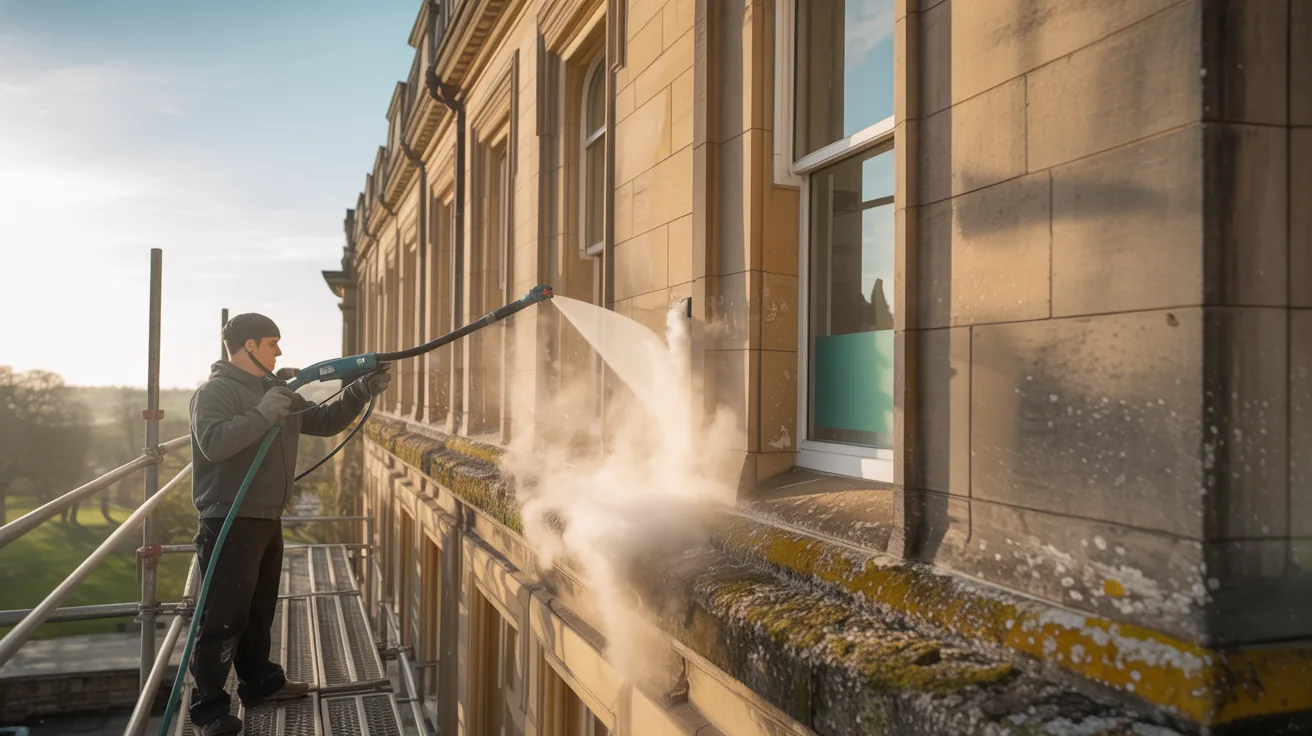
DOFF is a cleaning system that heats water to around 150C at the nozzle and delivers it at very low pressure, closer to a garden hose than a jet wash. Nothing is added to the water. Biological growth is killed by temperature, while carbon soiling, bird fouling and old lime wash soften in the heat and are gently flushed off. Because it is chemical free and low pressure, it is the method most conservation officers will accept on listed and historic stone.
DOFF is a superheated water system built for cleaning historic masonry without chemicals and without pressure. Water arrives at the nozzle at up to around 150C but leaves at very low pressure, so what does the cleaning is heat, not force. The temperature kills algae, moss and lichen along with the spores, and it softens carbon soiling and old organic staining enough for it to lift away from the face of the stone.
That combination is why the system is accepted on listed buildings and why conservation officers are comfortable with it. There is no biocide left in the stone to react with soluble salts later, no residue to bleed back out through the face, and the volume of water used is small enough that the fabric never gets saturated. Surfaces dry within hours rather than days, which matters on a solid walled building that has spent a century getting damp slowly and drying slowly.
Most of our DOFF work in Lancashire is sandstone and millstone grit: parish churches, manor houses, former mill buildings and conservation area terraces, plus the occasional gate pier and monument. Every job starts with a test patch and a conversation about what the finished stone should look like, because on a historic building the right answer is rarely the cleanest possible result.
Suitable for
- Listed sandstone houses, halls and farm buildings
- Church and chapel stonework, headstones and monuments
- Soot blackened millstone grit on former mill buildings
- Conservation area terraces and traditional shop fronts
- Lime mortared walls, gate piers and boundary copings
- Carved detail, mullions, string courses and window tracery
Problems it solves
- Black carbon soiling and sulphation crusts left by a century of mill and traffic pollution
- Algae, lichen and moss holding on shaded north facing stone
- Bird fouling and green staining under gutters, copings and sills
- A conservation officer or planning condition requiring a chemical free method
- Earlier damage from jet washing or grit blasting that must not be repeated
- Soft lime pointing that would not survive any form of pressure cleaning
How we approach doff superheated water cleaning
Survey and consent check
We look at the stone type, the mortar, the state of the pointing and any previous cleaning damage, then ask what has already been agreed with the conservation officer or planning department before anything is booked in.
Test patch
A small agreed area is cleaned first, usually somewhere discreet. You and, where relevant, the conservation officer see the finish and the settings used before we commit to a full elevation.
Access and protection
Scaffold, tower or podium is arranged to suit the elevation. Windows, timber, ironwork and open joints are protected, and we agree in advance where water is going to run and drain.
Cleaning the elevation
We work top down in sections at the lowest temperature and pressure that will do the job, adjusting as the stone changes. Carved detail and arrises are worked far more gently than plain ashlar.
Assessment and mason handover
Once the face is clean, defects hidden under the soiling become visible. We flag failed pointing, cracked stone and open joints so a mason can deal with them before weather gets into the wall.
Drying and records
The stone dries within hours because so little water is used. We walk the finished job with you and can supply photographs of the test patch and elevations for your planning records.
What you get
- No chemicals used, so nothing is left in the stone to bleed back or react with salts
- The DOFF system is English Heritage approved and accepted by conservation officers
- Kills growth and spores by temperature, so regrowth is slow without any biocide
- Very low pressure, so lime pointing, arrises and carved detail stay intact
- Low water volume, so solid walls are not saturated and dry within hours
- Shifts soot blackening on gritstone that softwashing alone will not touch
DOFF Superheated Water Cleaning questions
Related services
- Heritage Stone and Brick RestorationConservation-led cleaning of churches, listed farmhouses, mill buildin
- Brick CleaningMortar haze, soot staining and green growth taken off brickwork withou
- Brick Paint RemovalControlled removal of masonry paint from brick and stone using poultic
- SoftwashingLow pressure cleaning with a biodegradable biocide that kills algae, l
Need doff superheated water cleaning doing?
Free quotes, no obligation, and an honest answer about whether the job actually needs doing.