Heritage Stone and Brick Restoration in Leyland
Conservation-led cleaning of churches, listed farmhouses, mill buildings and conservation-area stonework, using methods a conservation officer will accept.
Family-run
Justin and the team do the work. No call centres, no subcontractors.
Fully insured
Full public liability cover on every job, domestic or commercial.
Safe methods
Biodegradable products and low pressure, matched to the surface.
Free quotes
No obligation, and no charge for coming out to look at the job.
Heritage Stone and Brick Restoration for Leyland property
Leyland is about 38 minutes up the road from us, well inside the patch we cover properly. Heritage stone in this part of Lancashire is mostly sandstone and millstone grit, and the weathered outer skin of both is the thing a clean has to protect, which is why every building gets a trial patch before it gets a price. Housing across PR25 covers period stone alongside newer render-fronted housing, which is why we look at the actual surface before quoting rather than pricing off a photograph.
There are 42 listed buildings within a couple of miles of Leyland. Work on protected fabric is not the place for guesswork, so we agree the method in writing and put a trial patch down before anyone cleans a whole elevation.
Heritage restoration cleaning is the removal of soiling, biological growth, paint and staining from historic stone and brick using methods gentle enough to leave the original surface intact. In practice that means superheated water rather than chemicals, low pressure rather than high, trial patches rather than assumptions, and a written method statement the local conservation officer can agree before any work begins.
While we are in Leyland we regularly pick up work in Clayton-le-Woods, Lostock Hall, Bamber Bridge and Penwortham, so if a neighbour wants the same job doing we can usually do both in one visit.
Suitable for
- Parish churches, chapels and church halls
- Listed farmhouses, manor houses and estate cottages
- Former mill buildings and industrial brickwork under conversion
- Conservation-area terraces, shop fronts and civic buildings
- Boundary walls, gate piers, sundials and memorials
- Sandstone and millstone grit elevations of any age
Problems it solves
- Black sulphation crust on sheltered stonework and carved detail
- Heavy algae, lichen and moss on north and west elevations
- Green and black staining running from failed gutters and hoppers
- Earlier abrasive cleaning that has opened up the face of the stone
- Paint, limewash or graffiti on a listed elevation
- A conservation officer who needs a method agreed before consent
How a Leyland job runs
Site visit and condition survey
We walk the building elevation by elevation and record stone type, the pattern of soiling, biological growth, open joints, failed rainwater goods and any damage from earlier cleaning. Photographs are kept with the record.
Method statement
A written statement sets out the equipment, temperatures, pressures and sequence we intend to use, along with protection for glass, lead, timber and planting. This is the document a conservation officer or architect will want to read.
Trial patches
Small patches are cleaned on each elevation that differs, because a sheltered south face and a wet north gable will never behave the same. Everyone agrees what an acceptable result looks like before we go further.
Access and protection
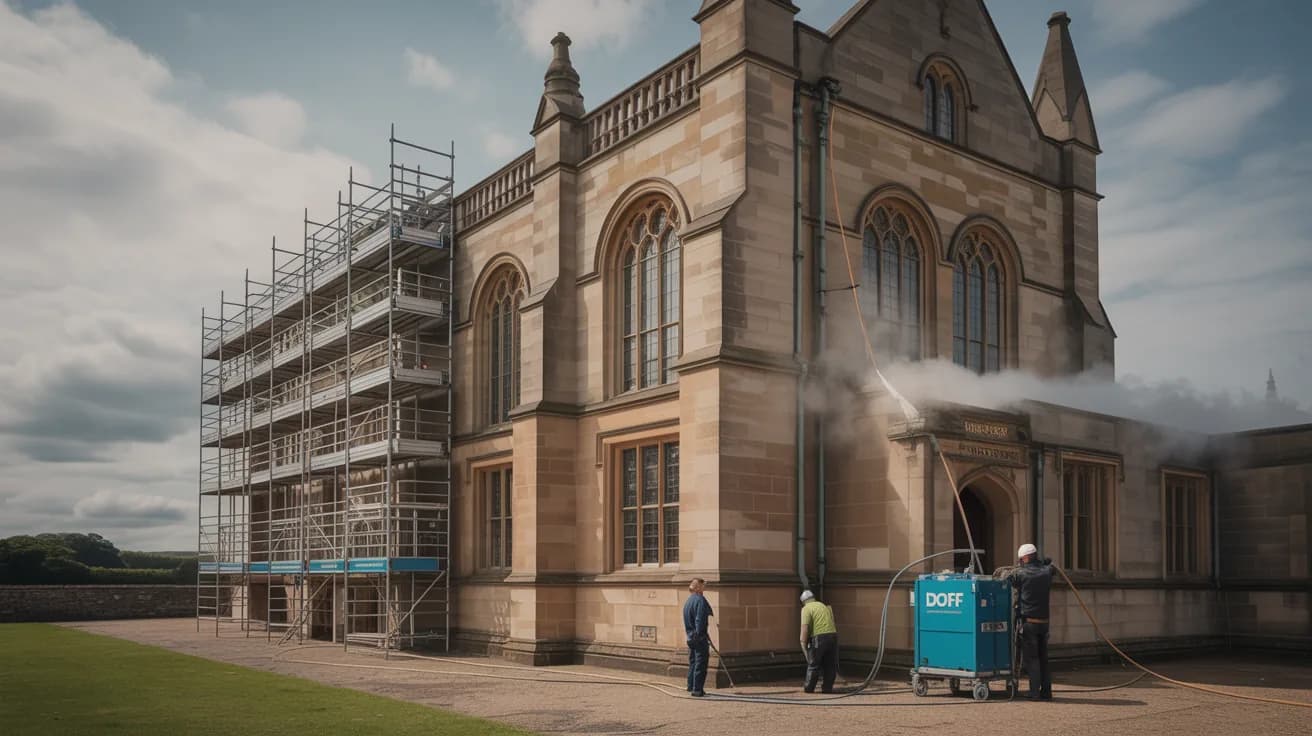
Scaffold or a suitable powered platform goes up with the building protected: leadwork covered, stained glass shielded, gravestones and planting sheeted, and drainage managed so run-off goes nowhere it should not.
Cleaning
DOFF is worked methodically across the elevation at low pressure with the water superheated at the nozzle. Where paint or graffiti is present, TORC takes it off. Soft, decayed areas are left alone and reported, never forced.
Handover and reporting
You get a record of what was done, photographs before and after, and a note of anything we found that needs a mason, a roofer or a joiner. We do not carry out repairs we are not qualified to make.
Heritage Stone and Brick Restoration in Leyland: your questions
Everything we do in Leyland
Heritage Restoration in nearby towns
- Heritage Restoration in Clayton-le-Woods36 minutes from Clitheroe
- Heritage Restoration in Lostock Hall38 minutes from Clitheroe
- Heritage Restoration in Bamber Bridge35 minutes from Clitheroe
- Heritage Restoration in Penwortham45 minutes from Clitheroe
- Heritage Restoration in Chorley41 minutes from Clitheroe
Heritage Stone and Brick Restoration in Leyland
Free quote, no obligation. We are 38 minutes away, so it is no trouble to come and look at the job.